
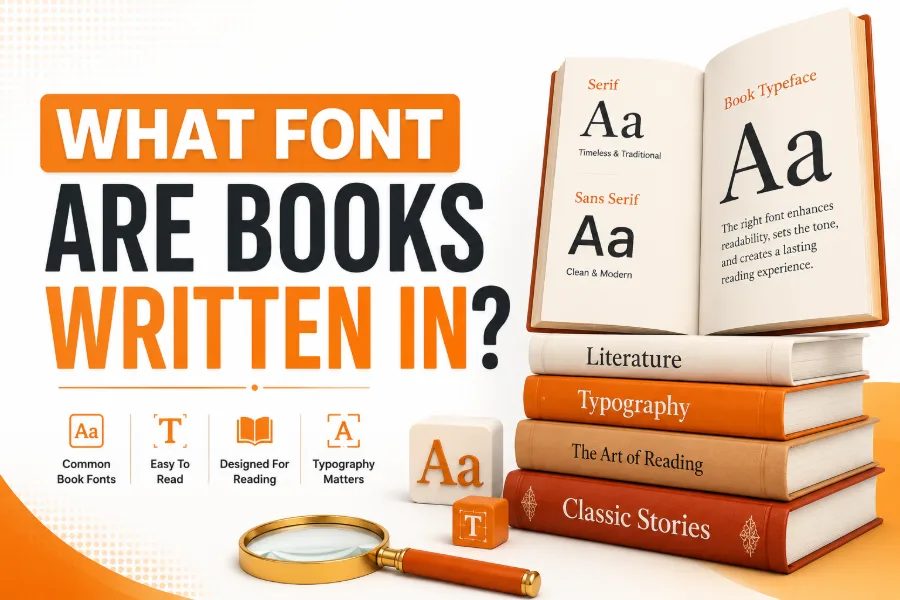
What font are books written in is a common question for authors, designers, and self-publishers who want their pages to look professional instead of homemade. The best answer is not one font name, because a readable book depends on genre, trim size, line spacing, paper, audience, and whether the book will be printed or read on a screen.
This guide shows you how to choose fonts that feel polished, support long reading sessions, and match the tone of your book from the first page onward.
What Font Are Books Written In For Print Books?
Most printed novels, memoirs, and nonfiction books are written in serif fonts because they guide the eye across long lines. Garamond, Caslon, Baskerville, Minion Pro, Palatino, Georgia, and Century are common choices because they look refined and stay comfortable across hundreds of pages. When you are experimenting with decorative title styles before settling on a serious interior typeface, a tool like font generator for stylish text and creative fonts can help you compare creative looks, but the final body font should still put readability before personality.
Print Test Before You Decide
The safest starting point for an adult print book is 10 to 12 points, with 11 points working well for many trade paperbacks. Your font should have open letterforms, clear punctuation, strong italics, and a full regular, italic, bold, and bold italic family. A font that looks beautiful in a menu can feel cramped in a chapter, so always test several full pages before committing.
Why Serif Fonts Still Dominate Book Interiors
Serif fonts remain popular because books ask readers to stay focused for long stretches. A classic serif creates rhythm and gives paragraphs a calm texture that does not fight the story or message. That is why many professional interiors use typefaces that feel almost invisible after the first page.
Garamond is often chosen for fiction because it feels elegant and literary without looking old-fashioned. Caslon suits memoir, essays, history, and thoughtful nonfiction because it carries authority while staying human. Baskerville has sharper contrast and a more formal mood, making it useful for literary fiction, academic-leaning books, and serious nonfiction.
Best Serif Fonts For Books By Genre
For novels, Garamond is a strong default because it looks graceful and performs well in long chapters. For historical fiction, literary fiction, and memoir, Baskerville or Caslon can add a traditional voice without making the page feel dated. If your book uses classic references, chapter ornaments, or old-world styling, a themed resource such as a Latin font generator can inspire display lettering ideas, while the body text should remain a professional serif that readers can follow easily.
For nonfiction, Minion Pro, Charter, Georgia, and Caslon are practical choices because they combine clarity with seriousness. For poetry, you can often use a slightly larger size, because white space, line breaks, and page balance matter as much as continuous reading speed. For children’s chapter books, choose a larger, friendlier typeface with simple shapes, generous spacing, and clear letter differences.
Best Sans Serif Fonts For Modern Book Design
Sans-serif fonts are not usually the first choice for long printed body text, but they work well in headings, captions, callouts, tables, workbooks, and modern nonfiction. Helvetica, Arial, Avenir, Futura, Roboto, and Myriad can make a page feel clean, direct, and current when they are used with restraint. If your project involves invitations, romantic chapter titles, or elegant display lettering, a wedding font generator can show ornamental ideas for special text, but your main pages need simpler fonts that protect reading flow.
Sans-serif body text can work in short books, design books, educational materials, and digital-first projects where clean screens matter. The key is choosing a humanist sans-serif with open counters, readable lowercase letters, and enough spacing to avoid a crowded gray block. Avoid using a geometric sans-serif for dense chapters unless you have tested it on the actual trim size.
What Font Size Should A Book Use?
Most adult print books use 10 to 12 point body text, but the right number depends on the typeface. Garamond often appears smaller than Georgia at the same point size, while some modern fonts look larger because of their x-height. You should judge the printed page, not the number in the layout software.
For chapter titles, 14 to 18 points is common, although literary books may use modest headings and nonfiction may use stronger hierarchy. Footnotes and endnotes often sit around 8 to 10 points, but they still need enough leading to avoid becoming a dense legal-style block. Children’s books often need larger type, with early-reader books sometimes using sizes that would look oversized in adult fiction.
Line Spacing, Margins, And Page Comfort
Font choice alone will not make a book readable if the typesetting is weak. Leading, which is the space from one line baseline to the next, often works best around 120 to 140 percent of the body font size, although some books need more air. If the lines feel stacked too tightly, the reader’s eye struggles to return to the next line.
Line length also matters because very long lines tire the reader and very short lines create choppy movement. A practical target is around 50 to 75 characters per line, depending on trim size and typeface. Margins should create a balanced page, leave room near the gutter, and avoid pushing the text too close to the edge.
What Fonts Should You Avoid In Books?
Avoid handwriting fonts, brush fonts, novelty fonts, symbol fonts, and highly decorative display fonts for body text. These styles can work on a cover, title page, opener, or short quote, but they become tiring across pages. A good book font should support the words, not compete with them.
You should also be careful with Times New Roman in finished interiors. It is fine for manuscripts and drafts, but it can make a published book feel like a document rather than a crafted reading experience. If you use it, do so intentionally and improve the surrounding layout with strong spacing, margins, and hierarchy.
How To Pair Fonts In A Book
A simple book usually needs one body font and one heading font, not a crowded collection of styles. You can pair a classic serif body font with a clean sans-serif heading font to create contrast without confusing the page. For example, Garamond with Avenir or Caslon with Helvetica can feel balanced when sizes and weights are handled carefully.
Do not pair two fonts that look almost the same, because the difference may feel accidental instead of designed. Do not pair two fonts that both demand attention, because the page will feel noisy and amateur. A good pairing has clear roles: one font carries the reading, and the other helps readers navigate sections.
Ebook Font Choices And Reader Control
Ebooks are different because readers can often change the font, size, spacing, and theme on their device. That means your ebook design should use clean structure, proper heading levels, and reliable font choices rather than depending on one exact visual layout. Arial, Georgia, Times New Roman, and other widely supported fonts can work, but the formatting must remain flexible.
For ebooks, avoid locking the reader into tiny text or complex decorative typography. Keep chapter headings clear, use proper paragraph styles, and make sure italics, bold text, lists, and links behave correctly after conversion. A beautiful ebook is a file that adapts well across Kindle, tablets, phones, and accessibility settings.
How Genre Should Guide Your Font Choice
Your font should match the promise your book makes before the reader even finishes the first page. A thriller may need sharp, efficient typography that keeps the pace moving, while literary fiction may benefit from a warmer serif with a quiet texture. A business book often needs headings, subheadings, bullets, and charts that look organized rather than decorative.
Romance, memoir, history, poetry, children’s books, and academic nonfiction all carry different expectations. A romantic novel can use elegant chapter titles, but the paragraphs still need a readable serif. A workbook or self-help guide can use more sans-serif elements because readers scan, pause, write notes, and move between sections.
A Practical Book Font Selection Process
Start by choosing three body fonts that fit your genre and publishing format. Set the same chapter sample in each font, using the same trim size, margins, size, and line spacing, then print the pages if the book will be printed. Read each sample like a real reader, not like a designer looking for beauty in isolated letters.
Next, check the italic style, bold style, numbers, punctuation, quotation marks, and special characters. Many books fail visually because the alphabet looks fine, but the italics feel weak or the punctuation looks awkward. Finally, ask whether the page feels trustworthy, calm, and easy to continue reading for ten minutes or more.
Font Licensing And File Preparation
Before publishing, confirm that the font license allows commercial use, print production, PDF embedding, and ebook use. Some fonts are free for personal use but not for products you sell, while others require a paid license for commercial publishing. This step protects you from avoidable legal and production problems.
When exporting your print-ready PDF, embed the fonts and inspect the file before upload or printing. Missing fonts can cause substitutions that change line breaks, page count, and the book’s look. A final proof should be reviewed on paper whenever possible because screens can hide spacing problems that appear clearly in print.
Final Checklist Before You Publish
Choose a serif body font for most printed books, then use sans-serif fonts mainly for headings, callouts, and modern supporting elements. Keep adult body text around 10 to 12 points, adjust leading for comfort, and test your actual trim size before deciding. Use decorative fonts sparingly, because covers and chapter openers can carry personality while body pages carry the reader.
Final Review Questions
Your final review should answer a few simple questions before the book goes live. Can you read five pages without noticing the font, and does the page look calm, balanced, and professional? Are headings, captions, footnotes, and body text clearly separated, and are the fonts licensed, embedded, and proofed correctly?
Conclusion
What font are books written in depends on the kind of book you are creating, but most professional print books use readable serif fonts such as Garamond, Caslon, Baskerville, Minion Pro, Georgia, or Palatino. Your best choice is the font that makes your pages feel natural, supports your genre, and stays comfortable across full chapters.
Do not choose a font only because it looks stylish in a short sample, because books demand endurance, rhythm, and consistency. The strongest book interiors often feel simple because every choice has a job: the body font carries the reading, the headings organize the journey, and the spacing gives the eyes room to move. When you combine the right font with proper size, leading, margins, hierarchy, licensing, and proofing, your book stops looking like a draft and starts feeling like a finished publication for readers.